

- What is the best way to pay for home gym equipment without paying all at once?
- Buy now pay later for home gym equipment: who offers what
- Interest-free store finance: what "zero percent" actually means
- Lay-by vs rent-to-own: the real total cost
- Personal loans for gym equipment: when the numbers make sense
- Pitfalls and penalties that catch buyers off guard
- Paying for a home gym without paying all at once: choosing the right method for your budget
- The bottom line
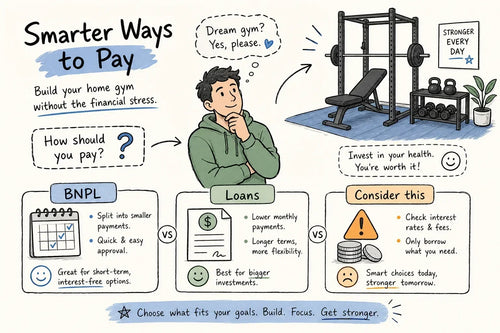
So, what is the best way to pay for home gym equipment without paying all at once? It depends on your budget, your credit profile, and how quickly you want to start training, but the good news is that there are several legitimate options worth comparing. A typical Australian home gym setup can cost anywhere from $800 to well over $5,000 depending on what you include, which puts the full upfront cost out of reach for most people. Paying it all at once should not be a requirement. Buy Now Pay Later (BNPL), interest-free store finance, lay-by, and personal loans each work differently, and choosing the wrong one can cost you more than you expect.
At Rug and Rig Fitness, we offer BNPL options across our home gym range precisely because a quality setup should not have to wait until you have saved the full amount. This guide breaks down each payment method honestly, what it costs, what the risks are, and which option suits your budget best.
What is the best way to pay for home gym equipment without paying all at once?
The short answer: it depends on your purchase size. For most buyers spending under $2,000, buy now pay later for home gym equipment is the simplest and most cost-effective route. For larger setups, interest-free store finance or a personal loan may serve you better. The sections below walk through each option in detail so you can compare them on equal terms.
Buy now pay later for home gym equipment: who offers what
The BNPL market in Australia has expanded significantly in recent years, and sporting goods and gym equipment are consistently among the most purchased categories across the major providers. The core mechanics are similar across providers: you receive the gear now and pay in instalments. But the credit limits, fees, and repayment schedules vary enough that choosing the wrong provider can cost you real money.
Afterpay and Klarna: best for purchases under $2,000
Afterpay splits your total into four fortnightly payments, with the first due at checkout. No interest applies if you pay on time, but late fees apply if you miss a payment. The initial charge is $10, with an additional $7 added if it's still unpaid after seven days, capped at 25% of the order value or $68, whichever is lower. Klarna works on a similar pay-in-four model with comparable conditions. Both providers work well for starter bundles, adjustable dumbbells, or a bench-and-kettlebell combination.
Both providers cap merchant limits at roughly $1,000 to $2,000 depending on the retailer, which may not stretch far enough for larger setups.
Zip and Humm: better suited for full gym setups
Zip Pay covers up to $1,000, but Zip Money extends to $5,000 or higher with some merchants and lets you spread repayments over several months, making it a practical option for mid-range home gym builds. Humm offers two tiers: Little Things covers up to $2,000 with no interest across five or ten fortnightly payments, while Big Things reaches up to $7,500 with monthly repayments over up to 24 months and a small monthly fee. For a power rack, barbell, and bench package in the $2,000 to $4,000 range, Zip Money or Humm Big Things are the more practical choices. They offer a longer repayment window and a higher credit limit than Afterpay or Klarna at that price point.
How BNPL works at Rug and Rig Fitness
BNPL is available across the Rug and Rig Fitness range, from compact starter bundles through to complete strength setups. Select your preferred BNPL provider at checkout, spread the cost over weeks or months without drawing on your savings, and our standard warranty and returns policy applies in full. If you want to confirm which providers are available at checkout before placing your order, contact our team directly.
Interest-free store finance: what "zero percent" actually means
"Zero percent interest" is one of the most misunderstood offers in retail finance. It is not free money; it is a promotional window, and the fine print determines whether it stays free or becomes expensive.
The difference between promotional 0% and genuinely interest-free
Most Australian fitness retailers offering 0% APR finance run a deferred-interest arrangement: no interest applies during the promotional window, commonly six, twelve, or 24 months, but if you don't clear the balance before that period ends, interest can apply from the original purchase date or from that point forward. This differs from BNPL, where the product is genuinely interest-free as long as you pay on time. Reading the product disclosure statement before committing, not after, is the single most important step with any store finance offer.
Eligibility requirements and fees to check first
Interest-free store finance usually requires a credit application and approval. Common eligibility conditions include being 18 or older, earning above a minimum annual income (some providers require $25,000 or more per year), holding Australian citizenship or permanent residency, and having a clean credit file.
Minimum purchase amounts for these offers typically start somewhere between $460 and $1,000 before the 0% promotion activates, the threshold varies by retailer. Several store finance products also charge a monthly account fee of $6 to $9.95, even when the interest rate is zero. Over a twelve-month term, that adds $72 to $120 to your total cost, which is worth factoring into your comparison before you sign.
Lay-by vs rent-to-own: the real total cost
These two options are often grouped together, but they work very differently and carry very different total costs. Understanding the distinction before you commit can save you hundreds of dollars.
How lay-by works and when it makes sense
Lay-by is a deferred purchase: you pay the retailer in instalments, and the equipment stays at the store until you have paid in full. There is no interest, and the total price stays close to the cash price. The main downside is that you cannot use the gear until the final payment clears. Cancellation or administration charges may apply if you withdraw mid-way, but under Australian Consumer Law any termination charge must reflect the retailer's reasonable actual costs rather than a penalty. Lay-by suits buyers who are not in a rush and want to avoid any form of credit entirely.
Why rent-to-own almost always costs significantly more
Rent-to-own lets you take the equipment home immediately and pay weekly or monthly, with ownership transferring once all payments are complete. The access is immediate, but the total cost is typically far higher than the cash price. Consumer-leasing data shows total costs that can exceed the retail price by well over 100% across the contract term. A treadmill with a cash price of $870, for example, can end up costing over $1,300 under a rent-to-own agreement. These contracts also tend to be marketed as "no credit check required," which typically indicates the product is aimed at buyers with limited credit options rather than those seeking value. Unless you have exhausted every other option, rent-to-own is worth avoiding.
Personal loans for gym equipment: when the numbers make sense
A personal loan is not the first option most people consider for gym gear, but for larger setups it can be a structured way to fund the purchase with a fixed repayment schedule and a defined end date.
Realistic rates and minimums in Australia right now
Unsecured personal loan rates in Australia currently range from around 5.7% to 30% per annum, depending on your credit profile and the lender, figures consistent with rates published by major lenders and comparison services in 2026. Most mainstream lenders set minimum loan amounts of $2,000 to $5,000, which means a $500 or $800 purchase will not qualify for a standard personal loan. Application fees can range from zero to $395, and some lenders charge a monthly account fee on top. Always check the comparison rate, which folds in fees, rather than the headline rate alone.
How repayments compare across common purchase sizes
The figures below are illustrative, based on standard loan calculator methodology. At 10% per annum over a three-year term, a $1,500 loan costs roughly $48 per month and a $5,000 loan costs roughly $161 per month. At a higher rate of 20% per annum, those same loans rise to about $57 and $185 per month respectively. For a complete home gym setup in the $3,000 to $5,000 range, a personal loan can make sense if you want one fixed repayment and a defined finish line. For anything under $2,000, BNPL or interest-free store finance will almost always be cheaper and easier to access.
Pitfalls and penalties that catch buyers off guard
Every payment method carries some risk. Understanding those risks before you sign up is the difference between a smart purchase and an expensive mistake.
Late fees and credit file damage with BNPL
BNPL providers charge no interest when you pay on time, but missed payments trigger late fees that can escalate quickly. ASIC has examined BNPL fee structures and noted that these charges can represent a significant effective cost when expressed as an equivalent annual rate, even though they are not classified as interest. Beyond the fees, missed BNPL payments can now appear on your credit file in Australia under Comprehensive Credit Reporting rules, affecting your ability to obtain a mortgage, car finance, or other credit in future. A missed payment that remains unpaid for 60 days or more can be listed as a formal default, which stays on your file for five years.
Deferred interest traps and secured finance risks
With store finance, the most common trap is the deferred-interest reversal: if you have not cleared the full balance by the end of the promotional period, interest may apply retroactively or begin accumulating from that date. Some store finance products are also secured against the goods, meaning the lender can repossess the equipment if you fall seriously behind. That is a different risk profile from BNPL, where the worst outcome is fees and credit file damage rather than losing the item itself.
Before signing up for any payment arrangement, confirm three things: the total amount you will pay over the full term, whether there are account or establishment fees beyond the stated rate, and what happens if you miss a payment. Those three questions will expose most of the costs that standard rate comparisons miss.
Paying for a home gym without paying all at once: choosing the right method for your budget
With four main options available, the right choice comes down to purchase size, how quickly you want the gear, and whether you have existing credit commitments.
A simple decision framework by purchase size
For purchases under $2,000, BNPL through Afterpay or Klarna is usually the simplest and cheapest option if you can manage the fortnightly payments. Spending between $2,000 and $5,000 opens up Zip Money or Humm Big Things, which extend your repayment window to a more manageable amount, a 0% store finance offer also works well here, provided you can clear the balance before the promotional period ends. Above $5,000, a personal loan gives you a structured repayment schedule without the risk of hitting a BNPL credit limit. Lay-by suits anyone who wants to avoid credit entirely and is comfortable waiting. Rent-to-own is worth skipping unless every other option has been ruled out.
When BNPL at Rug and Rig Fitness is the smart move
If you are building a home gym in the $1,500 to $4,000 range and you want your equipment delivered now without a lengthy credit application process, BNPL through Rug and Rig Fitness is worth considering as your first option. You can split the cost into manageable fortnightly payments and still have the protection of our warranty and returns policy on every piece of equipment. Get in touch with our team if you want help matching a package to your budget and preferred payment method before you commit.
The bottom line
If you are still asking what is the best way to pay for home gym equipment without paying all at once, the honest answer is that it depends on your purchase size and your credit position, but the decision is simpler than it looks once you compare total costs rather than weekly figures. BNPL is the easiest option to access and works well for most home gym budgets, particularly for smaller purchases where you can comfortably meet the fortnightly schedule. Interest-free store finance can be competitive for larger purchases if you clear the balance on time. Lay-by keeps things simple with no credit involved. Personal loans make sense for bigger setups where a fixed monthly repayment is preferable. Rent-to-own is almost always the most expensive route available.
Whatever your budget, start by calculating the total amount you will pay over the full term, not just the weekly or fortnightly figure. That single step will tell you more than any headline rate, and it will make the difference between a home gym that costs what you expected and one that costs considerably more. Compare your options, check the comparison rate, and choose today.