

- 1. Understand the Different Types of Squat Racks
- 2. Assess Your Space Honestly
- 3. Determine Your Workout Needs
- Types of Exercises
- 4. Prioritise Stability and Durability
- 5. Set a Realistic Budget
- 6. Read Reviews and Real User Experiences
- 7. Know Where and How to Buy
1. Understand the Different Types of Squat Racks
Before you buy, it helps to know what you're actually looking at. Not all squat racks are the same, and the right type depends on how you train, how much space you have, and your goals.
Power Rack (Full Cage)

Half Rack (Half Squat Rack)

Squat Machine (Smith Machine / Plate-Loaded Squat Machine)

A squat machine typically refers to a Smith machine (where the bar travels on a fixed vertical track) or a plate-loaded squat machine (like a hack squat or pendulum squat). These offer guided movement, which can help with rehabilitation or for beginners learning movement patterns.
2. Assess Your Space Honestly
One of the most common mistakes home gym builders make is buying equipment that doesn't fit their space. Before you even look at a single product, grab a tape measure and get familiar with your room.
Home Gym Layout
Available Space and Height Considerations
3. Determine Your Workout Needs
Your squat rack should support not just where you are now but where you're heading. Think about the full range of exercises you want to perform and whether your rack can support them.
Types of Exercises
A well-specified power rack opens up an enormous variety of movements, including:
- Lower body: Back squats, front squats, box squats, split squats, Romanian deadlifts, rack pulls
- Upper body: Bench press, incline press, flat press, overhead press, barbell rows
- Bodyweight / calisthenics: Pull-ups, chin-ups, dips (with attachments)
- Functional: Band-resisted work using band pegs, cable exercises with a cable attachment
- If you know you'll want to do heavy bench press alongside your squat training, look for a rack with wide uprights and safety bars set at the right height range for both movements.
Squatting in the Rack
One thing beginners sometimes overlook: the depth and internal width of a power rack matters for squatting comfort. A rack that's too shallow makes it harder to step out and address the bar comfortably. Look for an internal depth of at least 55–60cm and clear internal width of 100cm or more for comfortable movement.
Combining a Bench and Squat Rack

4. Prioritise Stability and Durability
Your squat rack is going to take a beating — especially once you start loading serious weight. Stability and build quality aren't features to compromise on.
What to Look For
- Steel gauge: Look for 11-gauge (or lower gauge number, which means thicker) steel for uprights and frames. Thinner steel flexes and wobbles under load.
- Weight capacity: Check the manufacturer's stated weight capacity, but look for racks rated well above your current max — at least double your anticipated working load.
- Welds: Clean, consistent welds at all joint points. Rough or inconsistent welds are a red flag for quality control.
- Base footprint: Wider bases are more stable. Some racks can be bolted to a concrete or rubber floor for added security — highly recommended for heavy lifting.
- Upright uprights: The hole spacing on the uprights determines how precisely you can adjust the bar height and safety arms. J-hook and safeties that don't wobble in their holes are essential.
A rack that wobbles, flexes, or shifts under load isn't just annoying — it's dangerous. Invest in quality the first time.
Adjustable Heights and Safety Features
Adjustable J-hooks (the curved brackets that hold the bar) and safety arms are non-negotiables for a safe lifting environment. Look for:
- Close hole spacing (5cm or less) for precise height adjustments
- Lined or UHMW-protected J-hooks to protect your bar's knurling
- Solid pin-and-pipe or flip-down safeties rated for your working loads
- Pull-up bar integrated into the top of the rack for added functionality
5. Set a Realistic Budget
Squat racks span a wide price range — from entry-level options under $400 to commercial-grade cages pushing $2,000 or more. Knowing what you get at each price point helps you make a smart decision.
| Budget Range | What You'll Typically Get |
| Under $400 | Basic squat stands or entry-level half racks. Light-gauge steel, limited adjustability, lower weight capacity. Fine for light-to-moderate loads. |
| $400–$800 | Solid half racks and entry-level full power racks. Better steel, more adjustability, adequate for most recreational lifters. |
| $800–$1,400 | Mid-range full power racks with good steel quality, solid safety systems, and useful attachments included. The sweet spot for serious home gym builders. |
| $1,400+ | Commercial-grade racks built to gym standards. Higher gauge steel, more attachment options, higher weight capacities, longer warranties. |
Best Value for Quality
The best value isn't always the cheapest — it's the rack you won't need to replace in 18 months. Our range is priced to give you commercial-grade engineering without the commercial-gym price tag, and every rack is backed by our warranty and 30-day money-back guarantee.
We are also huge fans of our bundled packages because they solve the "what else do I need?" problem in one hit. If you're starting from scratch, a rack package with plates, barbell, and bench will always work out cheaper than buying each piece separately.
6. Read Reviews and Real User Experiences
Before committing to any squat rack, do your homework. Reviews from real users will tell you things a product listing never will — how it actually feels to assemble, whether the quality matches the marketing, and how the company handles problems.
What to Look For in Reviews
- Assembly experience: Is it straightforward with clear instructions, or a frustrating mess?
- Real-world stability: Does it feel solid under a heavy load, or does it flex and wobble?
- Durability over time: Reviews from buyers who've had the rack for 12+ months are particularly valuable
- Customer service: When something goes wrong (a missing bolt, a damaged upright in transit), how does the brand respond?
- Verified purchases: Weight reviews from verified buyers more heavily than anonymous comments
What the Rug and Rig Fam Say
Our customers share their experiences on Trustpilot and across our social channels — and the themes that come through most consistently are build quality, how the racks perform under real training loads, and the support they receive from our team when they have questions
The most popular setups among our community:
- Commercial Rack Package — The go-to for lifters who want to buy once and have everything sorted, including IWF-standard bumper plates and a quality Olympic bar
- Q235 Rack with Jammer Arms — Loved by functional fitness trainers and lifters who want more than just a squatting cage
- 60x60 Rack Package — The garage gym favourite, especially among urban lifters who've turned a tight space into a serious training room
7. Know Where and How to Buy
Once you've done your research, the final decision is where to make the purchase.
Online vs. In-Store Options
- Stocks locally (not drop-shipped from overseas), so you're not waiting weeks for delivery
- Offers same-day or fast dispatch so you can get training quickly
- Has an Australian customer support team who actually knows the product
- Backs the purchase with a real warranty and return policy
What to Check Before You Buy
- Shipping costs: Our racks ship free within Melbourne. For the rest of Australia, shipping is approximately 10% of the product value — factor this in when comparing prices across retailers
- Warranty: Every Rug and Rig rack comes with our manufacturer's warranty — minor faults resolved within 45 days, major faults assessed case-by-case
- Return policy: Not satisfied? Our 30-day money-back guarantee means you can buy with confidence
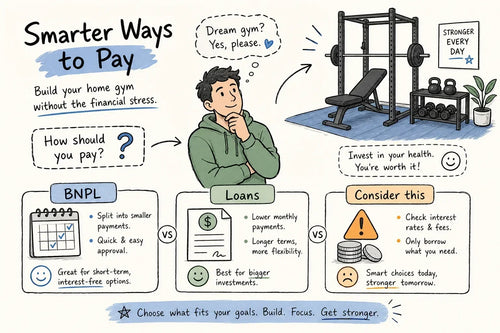
- BNPL options: We offer Buy Now, Pay Later financing — so you can start training now and spread the cost over time
Ready to Find Your Rack?
- Limited space? → 60x60 Power Rack Package — commercial stability in a compact footprint
- Want full versatility with jammer arms? → Q235 Steel Rack Package — the complete functional training setup
- Starting from scratch and want everything in one hit? → Commercial Rack Package — rack, plates, barbell, and adjustable bench, ready to go